What is inclusive writing? In order to adapt to new concepts of gender in society and avoid discrimination, it is suggested to use neutral wording (gender-inclusive writing) or, when this is not possible, to ensure that there is a balance in men and women representation.
Here are some basic guidelines1 for more inclusive writing that are not cumbersome. Note that simply stating from the outset that the masculine is used for the purpose of brevity is not adequate.
- Omit courtesy titles
Omit the courtesy title (e.g., Mr., Mrs., Ms.) when writing to or about a specific person.
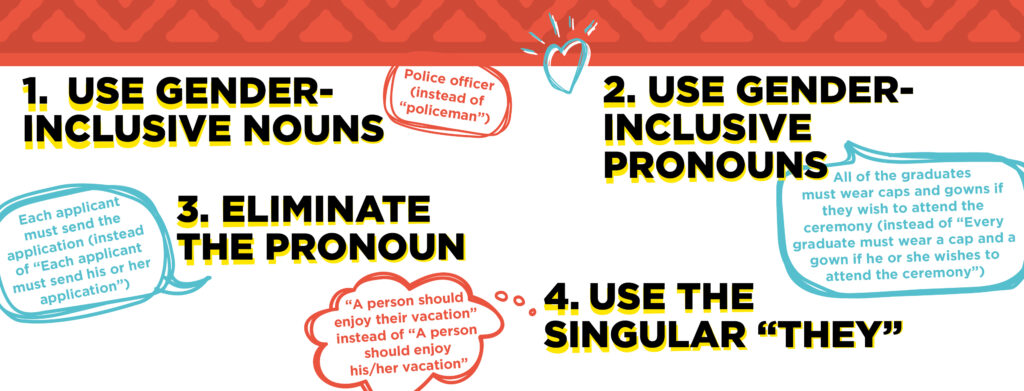
- Use gender-inclusive nouns
Use neutral nouns that do not specify gender:
- Spouse (instead of “husband” or “wife”)
- person (instead of “man” or “woman”)
In particular, avoid nouns formed from the word “man” and nouns with feminine endings:
- police officer (instead of “policeman”)
- humanity (instead of “mankind”)
- proprietor (instead of “proprietress”)
- property owner (instead of “landlady”)
- Use gender-inclusive pronouns
Use second person (you) instead of third person (he; she; he or she):
- Send your application (instead of “The applicant must send his or her application”)
Use plural nouns or pronouns with “they” or one of its forms:
- Applicants must send their application by December 31 (instead of “The applicant must send his or her application by December 31”)
- All of the graduates must wear caps and gowns if they wish to attend the ceremony (instead of “Every graduate must wear a cap and a gown if he or she wishes to attend the ceremony”)
- Eliminate the pronoun
Replace a possessive pronoun with an article:
- Each applicant must send the application (instead of “Each applicant must send his or her application”)
Repeat the noun:
- A teacher can provide instruction to students even after the teacher’s official class hours have ended (instead of “A teacher can provide instruction to students even after his or her official class hours have ended”)
- Use the singular “they”
The plural pronoun “they” or one of its forms is often used in speech and informal writing to refer to a singular non-specific noun or indefinite pronoun:
- Every member has paid their due.
- I checked with everyone, and they have all finished their work.
There is growing acceptance for singular “they” in formal writing; and if none of the guidelines above fit the writing situation, singular “they” may be the only practical solution for gender-inclusive writing.
All efforts, both written and oral, can help provide a more welcoming and inclusive environment for all.